

The Book of Philippians
THE BOOK OF PHILIPPIANS
Pearls Born in a Prison
There is nothing especially beautiful about looking at an oyster. Its shell can appear rough, ordinary, and unimpressive, yet hidden within some oysters is a treasure of extraordinary beauty—a pearl.
A pearl is formed when an irritant becomes lodged inside the oyster. In response, layer after layer of nacre begins to cover what entered as an irritation. What began as an intrusion and an uncomfortable circumstance gradually becomes the setting in which something precious is formed. Pressure and irritation do not get the final word; beauty emerges from what once seemed only troublesome.
No one looking at the outside of the oyster could imagine the treasure being formed within.
That is a fitting picture of the book of Philippians.
Some treasures are discovered in palaces. Others are revealed in places no one would ever choose to go. Philippians is one of those treasures. Some of the most beautiful words ever written about joy, peace, contentment, purpose, strength, and knowing Christ came not from a man sitting comfortably in his study, but from an apostle living under Roman imprisonment.
Paul’s circumstances were uncomfortable, restrictive, and uncertain, yet the treasure within him was greater than the pressure around him. His chains could restrict his body, but they could not imprison the Christ who lived within him. Grace was greater than limitation, joy was greater than opposition, and the life of Jesus within Paul proved greater than everything happening to Paul.
This is one of the great themes we will discover throughout Philippians: the Christian life is not determined primarily by what is happening around us, but by the Christ who is living within us.
Paul’s prison did not create Christ in him. It revealed Christ through him.
That is the exchanged life.
Paul could exchange frustration for purpose, weakness for grace, anxiety for peace, earthly confidence for confidence in Christ, and even the fear of death for the certainty of gain. Again and again, something lesser was released so that something greater could be experienced.
Those exchanges are the pearls we are going to uncover.
Philippians is only four chapters long, yet hidden within those chapters are truths capable of changing the way you see God, yourself, your circumstances, your relationships, and your future. These are not merely Scriptures to underline or ideas to admire. They are promises to believe, prophecies to anticipate, principles to live, and treasures to possess.
And behind them all stands the greatest Pearl of all—Jesus Christ Himself.
The Author — Paul the Apostle
Paul identifies himself at the beginning of the letter with these words: “Paul and Timothy, bondservants of Jesus Christ.” — Philippians 1:1 (NKJV)
Paul had once been Saul of Tarsus, a fierce persecutor of the early Church. Then one encounter with the risen Jesus on the road to Damascus radically transformed his life. The persecutor became a preacher, and the man who once imprisoned Christians would eventually find himself imprisoned because he belonged to Christ.
But Paul’s transformation was much deeper than a change in religious beliefs or behavior. His entire understanding of life changed. He eventually described it this way: “It is no longer I who live, but Christ lives in me.” — Galatians 2:20 (NKJV)
Paul had discovered the exchanged life.
He no longer saw Christianity merely as trying to become a better man or struggling to obey God through greater human effort. He discovered the mystery of Christ living within him. His strength was no longer his own strength, his righteousness was no longer his own righteousness, and his life was no longer centered upon himself.
By the time Paul wrote Philippians, these truths had been tested through extraordinary victories and tremendous suffering. He had experienced miracles, persecution, beatings, rejection, supernatural deliverance, church planting, hardship, and encounters with God that few people could imagine. He was not writing theories about victorious Christian living. He was writing truths that had been proven in the fire of his own experience.
That makes Philippians especially powerful. When Paul writes about joy, he knows sorrow. When he writes about peace, he knows pressure. When he writes about contentment, he knows lack. When he writes about pressing forward, he knows opposition. When he writes about strength, he knows weakness.
And when he declares, “For to me, to live is Christ, and to die is gain.” — Philippians 1:21 (NKJV), these are not simply beautiful words. They are the testimony of a man who had exchanged his old definition of life for an entirely new one.
For Paul, Jesus was no longer merely part of his life.
Jesus had become his life.
When and Where Was Philippians Written?
Philippians was most likely written around A.D. 60–62 during Paul’s imprisonment in Rome, although scholars have also proposed other locations for the imprisonment. Paul repeatedly refers to his chains and speaks of the palace guard, making it clear that this letter was born during a season of confinement.
Think about the contrast. Paul was restricted, yet his joy was unrestricted. His circumstances were uncertain, yet his confidence remained secure. His body could be chained, but the Christ within him could not be chained.
Before we study a single pearl, Paul’s circumstances are already teaching us something: what happens around us does not have to determine what happens within us.
The secret was not that Paul possessed extraordinary human strength. The secret was that Paul had learned to draw from another Life.
When human strength reached its limit, Christ remained sufficient. When circumstances offered no natural reason for peace, the peace of Christ remained available. When Paul could not control what happened around him, he could still surrender what happened within him to the Holy Spirit.
His prison could restrict Paul, but Paul’s prison could not imprison the Christ who lived within him.
The Church at Philippi — A Church Born Supernaturally
Paul’s relationship with the Philippians began years earlier during his second missionary journey. Acts 16 records how the Holy Spirit redirected Paul and his companions toward Macedonia. When they arrived at Philippi, God began building a church in a remarkable way.
The first recorded convert was Lydia, a successful businesswoman whose heart the Lord opened as Paul spoke. Then came a dramatic confrontation with a demonized slave girl who was delivered through the power of Jesus Christ. That deliverance created such opposition that Paul and Silas were beaten and thrown into prison.
At midnight, with their backs wounded and their feet fastened in stocks, Paul and Silas began praying and singing praises to God. Suddenly, an earthquake shook the prison, the doors opened, and everyone’s chains were loosed. The Philippian jailer, overwhelmed by what he witnessed, asked one of history’s greatest questions: “Sirs, what must I do to be saved?” — Acts 16:30 (NKJV)
That night the jailer and his household believed in Christ.
Think about how extraordinary this church was from its beginning. A businesswoman, a delivered slave girl, and a jailer were among the lives touched by the gospel in Philippi. Different backgrounds, different social positions, different stories—but one Jesus brought them together.
There is also something beautifully significant about Paul’s relationship with this church. Philippi had already seen him worship in prison. They had watched him praise God while his back was bleeding and his feet were in stocks. They knew that his theology of joy had been tested before he ever wrote about it.
Years later, Paul was once again imprisoned, writing to the believers in the very city where they had already witnessed the life of Christ flowing through him under pressure.
They knew his story.
When Paul wrote about joy in suffering, they knew he had lived it. When he wrote about peace, they knew he had experienced it. When he wrote about Christ becoming everything, they had already seen evidence of that exchanged life in him.
Why Did Paul Write Philippians?
Philippians is deeply personal. The believers at Philippi loved Paul and had supported his ministry financially. They had sent Epaphroditus to bring assistance to him during his imprisonment, and Paul wrote partly to thank them for their generosity and reassure them concerning his circumstances.
But the Holy Spirit had much more in mind.
Paul encouraged them to remain united, walk in humility, rejoice regardless of circumstances, guard their hearts from anxiety, renew their thinking, discover contentment, and above everything else, make knowing Jesus the great pursuit of their lives.
At the center of Philippians is not merely a collection of Christian principles.
At the center of Philippians is Christ.
Christ is our life.
Christ is our example.
Christ is our righteousness.
Christ is our greatest treasure.
Christ is our strength.
Christ is our sufficiency.
Christ is our coming King.
And every pearl ultimately leads us back to Him.
This is what makes Philippians so much more than a book about positive thinking, joy, or Christian behavior. Paul is revealing what life looks like when Jesus becomes our Source.
The call is not simply, “Try harder to rejoice.” It is to discover the joy of Christ within you.
The call is not merely, “Stop being anxious.” It is to exchange anxiety for the peace Christ provides.
The call is not simply, “Become more humble.” It is to let the mind and life of Jesus find expression through you.
The call is not merely, “Be stronger.” It is to discover, “I can do all things through Christ who strengthens me.” — Philippians 4:13 (NKJV)
Philippians continually moves us away from self-reliance and into Christ-dependence.
Why Philippians Can Change Your Life
Perhaps you have read Philippians many times. You may already know some of its verses by heart: “For to me, to live is Christ.” “Rejoice in the Lord always.” “I can do all things through Christ who strengthens me.” “My God shall supply all your need.”
But familiar Scriptures can still contain undiscovered treasure.
That is the invitation of Pearls from Philippians.
We are going treasure hunting.
Over these four weeks, we are not merely asking, “What does Philippians say?” We are asking something deeper: “Holy Spirit, what does this reveal about Christ within me, and what must I release so that His life can be more fully expressed through me?”
In Chapter 1, we discover Christ becoming our life. In Chapter 2, we discover Christ living His life through us. In Chapter 3, we discover Christ becoming our greatest treasure. And in Chapter 4, we discover how to live from the fullness we have found in Christ.
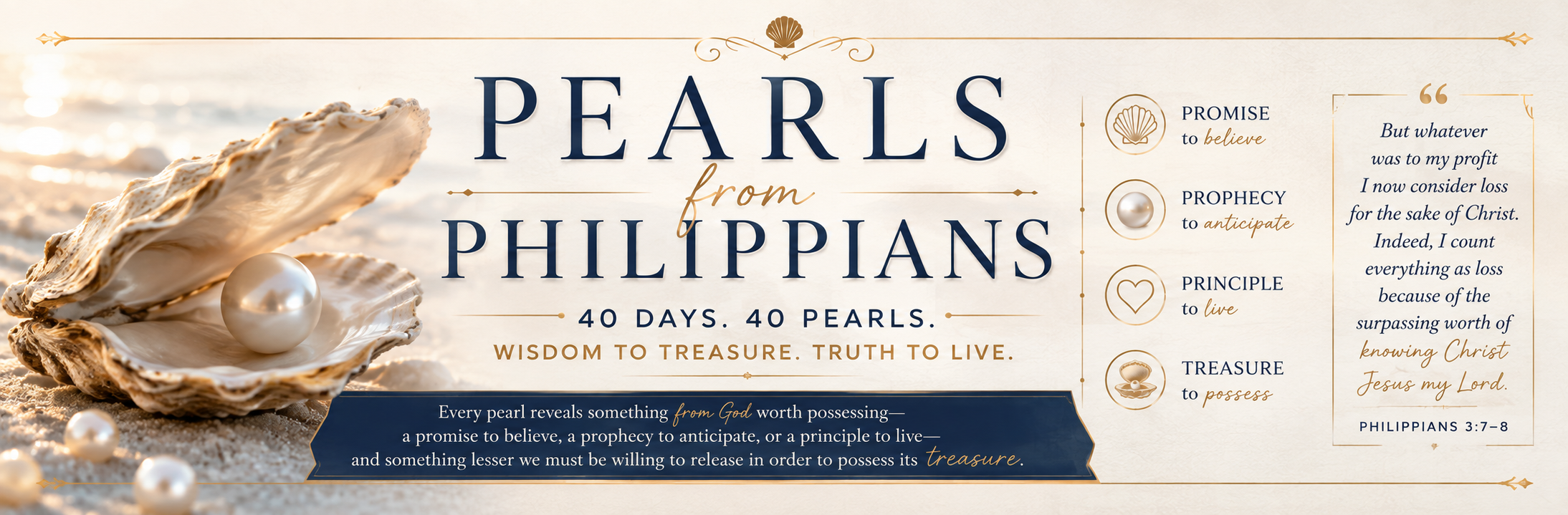
Along the way, we will uncover four kinds of pearls: a Promise to Believe, something God has declared that faith can embrace; a Prophecy to Anticipate, something God has revealed about what is yet to come; a Principle to Live, a Kingdom truth that transforms how we think and respond; or a Treasure to Possess, a spiritual reality already ours in Christ that we are learning to experience.
But remember the heartbeat of our journey: every pearl reveals something greater worth possessing and often something lesser we must release in order to experience it.
We exchange self-effort for surrender.
We exchange self-reliance for grace.
We exchange anxiety for peace.
We exchange offense for love.
We exchange resentment for joy.
We exchange our limited perspective for His divine perspective.
We exchange the need to magnify ourselves for the privilege of magnifying Christ.
We exchange earthly confidence for confidence in Him.
We exchange yesterday for the upward call ahead of us.
And ultimately, we exchange the self-directed life for the Christ-directed life.
This is not an exchange in which we lose something precious and receive something inferior. It is exactly the opposite. Every surrender makes room for something greater. We release what exhausts us to receive what strengthens us. We release what imprisons us to experience what frees us. We release what is temporary to possess what is eternal.
That is why the pearl imagery is so important.
A pearl is not valuable because of what had to be released. It is valuable because of what has been discovered.
And perhaps the greatest exchange in the entire letter is contained in Paul's declaration: “For to me, to live is Christ.”
We did not receive Jesus merely to add Him to our lives.
We received Him to become our life.
So open Philippians with fresh eyes. Read slowly. Meditate on it. Engage your God Imagination. Dig deeply. Ask questions. Pray over the words. Invite the Holy Spirit to take familiar verses and make them alive again.
As you read, continually ask: “What is the pearl in this passage? What is Christ revealing to me? What greater reality is already available in Him? What lesser thing am I still holding that needs to be surrendered?”
Do not simply collect information about the pearls.
Possess them.
Let peace replace anxiety. Let grace replace self-reliance. Let love replace offense. Let joy replace resentment. Let His mind replace old patterns of thinking. Let His strength become greater than your weakness. Let His life increasingly become the source from which you live.
By the time we reach the end of these 28 days, my prayer is not simply that you will know Philippians better. My prayer is that you will know Jesus better—and that His life will be more clearly seen through yours.
Because after we uncover every promise, anticipate every prophecy, embrace every principle, and possess every treasure, we will discover that every pearl was ultimately pointing us toward the same priceless treasure.
Jesus Christ Himself—the Pearl worth everything.
